Podcast: Play in new window | Download
Subscribe: RSS | Listen to the Property Developer Podcast
 Being both the builder and the developer might sound like a way to collect two margins. But who pays for the months of supervision, administration and project management before the properties sell?
In this episode, I speak with Anthony Awkar, an Adelaide builder and developer from Ora Projects, about the work, financial exposure and competing demands behind that model.
Anthony is sharing the numbers on a four-townhouse development, targeting a direct build cost of $280,000 per home, excluding GST. We unpack what that figure includes, what sits outside it, and how repeated designs, subcontracting and procurement choices shape his budget.
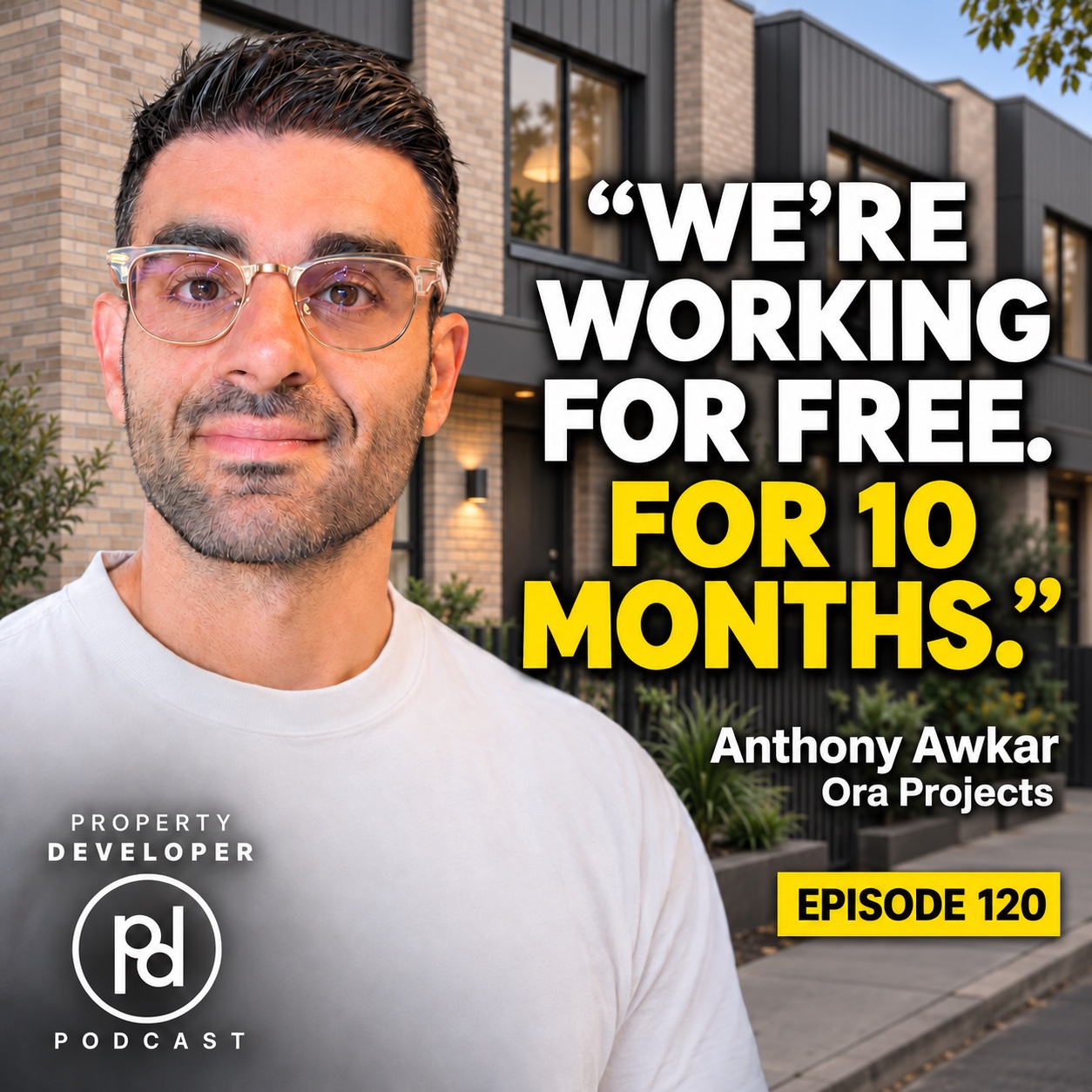
As Anthony explains, his building company isn’t charging a builder’s margin on the project:
“We’re working for free. For 10 months.”
The business is still contributing time and resources, while the eventual return depends on construction costs, delivery time and sale prices.
Anthony also shares how taking over his family’s struggling restaurant led to bankruptcy at 23, and how that experience changed the way he monitors cash flow and makes business decisions.
We discuss why builders can carry substantial costs between progress payments, when winning a job can be worse than walking away, and what developers can do before signing a building contract to reduce costly surprises.
In this episode we discuss
- Anthony’s path from the family restaurant into building and development.
- Going bankrupt at 23 and the lessons he took into his next business.
- Forecasting cash flow and preparing for different outcomes.
- Running a building company with an in-house team.
- Planning four street-facing townhouses on a 726-square-metre site.
- Targeting $280,000 per townhouse in direct build costs, excluding GST.
- Separating construction costs from the full development budget.
- Why Anthony plans to subcontract most of the townhouse construction.
- Assessing sale prices, holding costs and contingency before buying a site.
- The hidden workload and financial exposure of being both builder and developer.
- Knowing when to turn down work rather than cut the price too far.
- How progress payment schedules affect a builder’s cash flow.
- Reducing variations through detailed designs and confirmed selections.
- Understanding allowances, exclusions and the building contract before committing.
Top 5 takeaways from this episode
1. A build cost is only part of the development budget
Anthony’s $280,000-per-townhouse target is a direct construction figure, excluding GST. Builder’s margin, contingency, demolition and subdivision sit outside that number, alongside other development costs such as land acquisition and finance.
When comparing costs or assessing a site, establish exactly what each figure includes. A low construction rate alone doesn’t tell you whether the development works.
2. Being the builder doesn’t make your time free
Anthony’s building business is contributing supervision, administration and management without charging the development a builder’s margin. Those resources still have a cost, and the return for that work depends on the project’s eventual outcome.
His approach highlights an important feasibility question: have you accounted for everything the business contributes, even when no invoice changes hands?
3. Match the construction team to the project
Although Anthony employs his own team, he plans to subcontract about 90% of the townhouse construction.
His employees are set up for detailed architectural renovations and extensions. For four similar townhouses, specialist subcontractors can complete repeated tasks more efficiently. Having an in-house crew doesn’t automatically make it the best option for every job.
4. Pay attention to the gap between doing the work and getting paid
Anthony says his business had approximately $420,000 in work in progress at the end of the previous financial year. He explains how builders fund labour and materials between payment milestones, and why he pushes for more frequent progress claims.
For developers, understanding that cash-flow cycle can help explain the pressures on the business responsible for delivering their project.
5. Resolve the details before asking for a firm price
Unconfirmed selections and incomplete designs leave more room for allowances, misunderstandings and variations.
Anthony recommends documenting what you want—from joinery and finishes to landscaping—and understanding the contract’s inclusions and exclusions. He also encourages clients to have a construction lawyer review their contract before signing.
Doing more work upfront gives both parties a clearer understanding of what is being priced and delivered.
About Anthony Awkar
Anthony Awkar is an Adelaide-based builder and developer from Ora Projects.
After taking over his family’s restaurant at 21 and experiencing bankruptcy at 23, Anthony moved into construction, working across maintenance and renovations before obtaining his builder’s licence and establishing his own business.
His building company focuses on architect-led extensions and renovations, supported by an in-house team. At the time of recording, he was also progressing a four-townhouse development and sharing the costs and decisions behind it through social media.
Next Stage – Private Property Development Mentoring
Have a site to assess, a project challenge to work through or a bigger next move in mind?
Next Stage is my private, one-on-one mentoring program. We work through your opportunities and decisions, helping you test assumptions, identify priorities and move forward with greater confidence.
Find out more: https://www.propertydevelopertraining.com/mentoring
Property Developer Training
Learn what it takes to start and finish your first small-scale development. My online Property Developer Training program takes you through the process, from assessing sites and feasibility through to construction and completion.
Find out more: https://www.propertydevelopertraining.com
Property Developer Quiz
How ready are you to become a developer? Take my free quiz to see where your knowledge is strong and what you could work on next.
Take the quiz: https://www.propertydevelopertraining.com/quiz
Free Book – Become a Million Dollar Property Developer
Read the story of my first development—a 20-townhouse project—and the lessons I learned along the way.
Get your free digital copy: https://www.propertydevelopertraining.com/digital_book
Connect with the Property Developer Podcast
YouTube – https://www.youtube.com/@propertydeveloperpodcast196
Facebook – https://www.facebook.com/propertydeveloperpodcast
Instagram – https://www.instagram.com/property_developer_podcast/
LinkedIn – https://www.linkedin.com/company/property-developer-podcast
Episode links
Ora Projects – https://www.oraprojects.au/


